






The world has finally put a number on loneliness.
In June 2025, the World Health Organisation did something it had never done before: it measured how widespread the loneliness epidemic really is. The WHO Commission on Social Connection reported one in six people worldwide are affected by loneliness, and loneliness is linked to an estimated 100 deaths every hour across the world. Dr Vivek Murthy, the former US Surgeon General who co-chaired the Commission, called it a defining challenge of our time, but a completely addressable issue that responds wonderfully to human effort.
Statistics NZ’s most recent wellbeing statistics found 44% of us had felt lonely at some point in the previous four weeks. However, the data deserving the most attention is 4% of New Zealanders felt lonely most, or all, of the time. That’s roughly 208,000 people for whom loneliness has become a permanent state.
It is often assumed older adults and retirees feel the most acute effects of loneliness, due to the longer hours this generation are physically alone. However, and surprisingly, loneliness peaks among 15–24 year old’s, then falls steadily with each decade, before climbing again after 75, as health, mobility, driving and friends become less accessible.
Read that again. Your 50s, 60s and early 70s is the window of life where social connection and feeling part of a community can be most profound. This is the period where you’re busy, capable and mobile. It’s also where new connections can be developed and retained for the latter period of life.

It’s not just about mood. It’s about your brain.
The 2024 Lancet Commission on dementia found around 45% of dementia cases worldwide are potentially preventable or delayable by addressing 14 modifiable risk factors. Social isolation is a key risk, and it’s weighted heavily toward later life, meaning this is one lever still very much in your hands and influence at 55, 65 and 75.
The 88-year Harvard Study of Adult Development has published, when researchers looked at everything they knew about participants at age 50, the best predictor of how healthy they’d be at 80 wasn’t cholesterol. It was how satisfied they were with their relationships. Director Robert Waldinger notes those with closer relationships also held onto sharper cognitive function for longer.
Six things to make a real difference in your life
- Put it in the diary. Spontaneity is a young person’s transport system. After 50, the friendships that survive are the ones with a recurring calendar entry, the Tuesday walk, the Friday dinner, the six-week course. Structure builds a mental node of optimism and a sense of purpose, even if it is just a weekly catch up with friends – same place, same time every week.
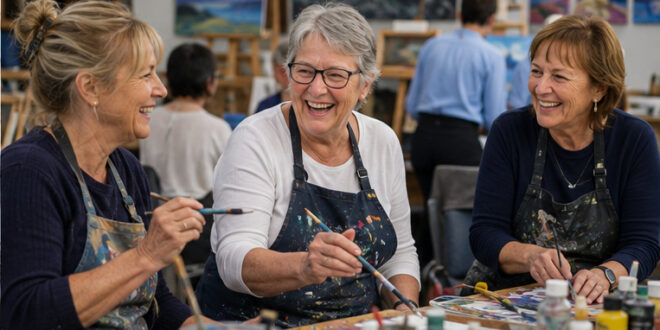
- Go shoulder-to-shoulder. “Let’s grab a coffee and catch up” puts two people under a spotlight with nothing to do but perform. Doing something together- a workshop, a restoration project, gardening, a tramp, an activity takes the pressure off and lets conversation arrive sideways.
- Learn something in a room full of strangers. This is a two-for-one. You get the cognitive stretch of genuinely new material, and you get a group of people who now share a reference point with you, which is, more or less, the raw ingredient of all friendship. At Love Heart, social learning for over 50s, they’ve seen everyone arrive at a Learning Lunch for the same two reasons: they’re there to learn and to connect with others.
- Retire the job, not the network. If most of your weekly conversation currently happens because of work, start to build a new network before you need one. While you have connections through work, sports, clubs or church, build it up. Develop connections outside of these environments and create rituals where you get together around a different interest such as going to the movies, or watching weekend sport.
- Bank your weak ties. The barista, the librarian, the bloke who sells you breakfast at the Saturday market. These micro-interactions won’t fill your week, but they keep you connected to a place, and they keep your small-talk muscles from seizing up, so when a real opportunity for friendship shows up, you’re match-fit.
- Be the one who invites. Someone has to be. Almost everyone feels a little awkward the first time they ask if someone wants to get together. Do it anyway, you’ll find people are far more grateful than you expected, because when it comes down to it, human connection is something we all crave.
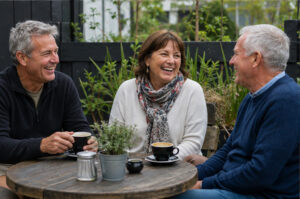
Twenty years ago, loneliness was overlooked or misunderstood. Today, we know so much more, and connection is being treated as a public health focus.
And you? You’re already the demographic doing this best. You travel. You’re curious. You’re reading a newsletter about staying sharp. The habit you’re being asked to build isn’t a hard one, it’s showing up somewhere regularly, with other people, around something interesting.
At Love Heart, they’ve long thought it’s not a bad description of a good life.
Because curiosity never retires. Neither should your friendships.
What is Love Heart?
Love Heart is New Zealand’s most vibrant learning community, specifically designed for active and curious adults aged 50+.
GROWN UPS OFFER for AUGUST & SEPTEMBEREnjoy one complimentary pass to any Love Heart workshop taking place in August or September in Auckland, Hawke’s Bay or online. Simply enter the code onetime26 on the Event Details page when booking. Limited to one per person. Click here to view all of Love Heart’s courses |
References
World Health Organization, From loneliness to social connection: charting a path to healthier societies, Commission on Social Connection, 30 June 2025 — who.int
Stats NZ, Wellbeing statistics: 2023 — stats.govt.nz
Rachel Judkins, “Are New Zealanders getting lonelier?”, The Spinoff, February 2025 — thespinoff.co.nz
Livingston G. et al., Dementia prevention, intervention, and care: 2024 report of the Lancet standing Commission, The Lancet, 31 July 2024 — doi.org/10.1016/S0140-6736(24)01296-0
Harvard Study of Adult Development, Harvard Medical School / Massachusetts General Hospital; see also Waldinger R. & Schulz M., The Good Life (2023) — adultdevelopmentstudy.org
Helen Clark Foundation, Alone Together (2020) — helenclark.foundation
Age Concern New Zealand — ageconcern.org.nz

Join the Discussion
Type out your comment here:
You must be logged in to post a comment.