






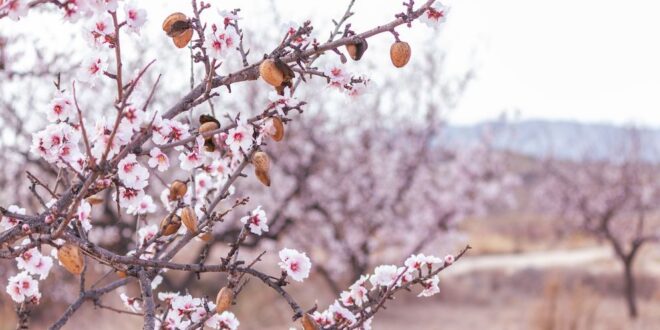
Blossom is a spring thing – right? So how can it be, when we’re not even half way through winter, some trees are already covered in delicate pale pink and white blooms? Is it climate change, or something much more natural? The answer is the latter! Fruit trees (and their non-fruiting relatives) blossom at very different times to one another, depending on their variety – and, yes, some really do prefer winter to strut their stuff! It can be for a number of reasons, including the fact trees are opportunists, and if they flower when little else is in bloom, they will attract insects, and guarantee pollination. Some of the earliest insects to be flying in the colder months are queen bumble bees in search of nectar. While double flowering, multi-petalled blossom will confuse these hardy insects, they will gather in numbers on the simple blossom of common prunus.
While we can’t hope to set our clocks by the flowering-time preferences of fruit trees and their ornamental relatives (weather is too fickle to allow us to do so), we can roughly predict what will be in blossom and when, and look forward to enjoying it. With this in mind, let’s take a look at what will be beautifying our streets, parks, and gardens, in the coming weeks and months:
Prunus campanulata (The Taiwanese Cherry)
One of the earliest trees to blossom in New Zealand, this deep pink-magenta tree with bell-shaped flowers is actually an invasive plant. It might feed the native birds, but if you see it, enjoy it briefly before you give it the chop!
Flowering cherries
Synonymous with Japan, come our ornamental cherries. There are literally dozens of varieties and they put on a magnificent display from mid to late winter, and right through to late spring. The frothy pink and sometimes delicate white blooms don’t result in fruit, but they set our hearts singing! If you have a smaller garden, you can still enjoy a flowering cherry when you choose Prunus ‘Amanogawa’ or Prunus ‘Shimidsu Sakura. These ‘narrow’ flowering cherry varieties naturally fit into a tight spot.
Almond trees
Almonds are another early blossoming tree, putting on a display in later July through to early September, flowering before the tree itself puts on any new growth for the season. The light pink buds look even more spectacular because they are born on leafless branches. Their highly aromatic perfume is an added bonus.
Apricot
Apricot trees blossom in early spring, which makes them susceptible to late frosts. But the risk is worth it, not only for the chance of fruit, but also for the sight of their deep pink sepals (the outer part of a flower) from which spring snow white petals cupped around bright yellow anthers. If you live in a warmer part of New Zealand, you can still enjoy the sight of apricot blossom (and, possibly, fruit,) when you choose a ‘low-chill variety such as ‘Fitzroy MB’ or ‘Royal Rosa.’
Apple and Pear
As spring advances, we can look forward to snowy white clouds of pear blossom, their centres flecked with bronzy anthers, and their delicate perfume luring in the pollinators. Apple tree blossoms offer more variety in colour and size, from pink tinged petals with pale yellow centres to the handsome ‘propellers’ of big apple varieties such as ‘Peasgood Nonsuch’ and ‘Monty’s Surprise.’ If you think you can’t fit an apple tree into your garden, look out for ‘slimline’ columnar varieties such as ‘Bolero’ and ‘Waltz.’ These narrow, upright, ‘Ballerina’ style trees are just the ticket for along the edge of your drive!
Blossom is what gets us through the winter, and often a chilly spring, as well. Watch out for different blossoms in your neighbourhood, and capture them on camera – or perhaps a canvas!

Join the Discussion
Type out your comment here:
You must be logged in to post a comment.