






Note: the following is not intended as professional advice. Always do your own homework before considering anything relating to tiny-homes.
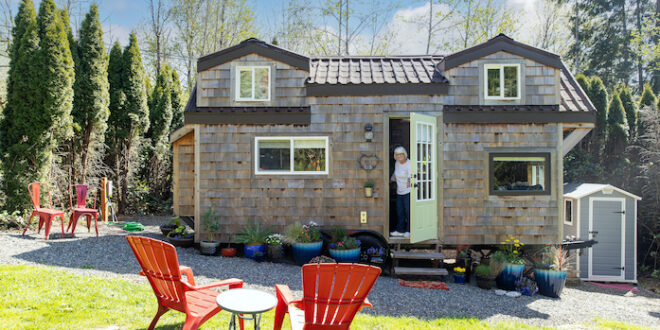
Welcome back to Home Sweet Home, where we check out living options for Kiwi seniors. Last month, we touched briefly on the ever-increasing range of accommodation solutions available to those wishing to downsize from the traditional family home. This month, we ‘zoom-in’ on tiny-homes, the home-ownership trend many seniors are seriously considering. We also invite you to read about the experiences of Alice, a senior tiny-home owner who walks the talk with over two years’ experience of living in this novel way. But first, just what is a tiny-home?
Tiny-homes
Over the last 15 or so years, ‘tiny-home’ has come to mean many different things to many people. For our purposes, we’ll go back to the beginning, when a tiny-home was considered a small house on wheels, capable of being towed. Generally speaking, that puts them in the 25-30 square meter range (although they can be smaller or larger). So how does a tiny-home differ from a traditional mobile home? Good question! Perhaps the main points of differentiation are ‘design’ and moveability. In a design sense, a tiny-house tends to look more like a ‘house’ (inside and out) than a mobile home. When it comes to moveability, a tiny-home, while able to be towed, is more likely to stay put. So far, so good – except for the ‘staying put’ part.
Different strokes for different folks
Because tiny-homes are still regarded as ‘non-standard’ in the accommodation sector, there are currently no nationally standardised regulations regarding where and how they can be sited. This means almost every local authority in the country has its own regulations which must be complied with before you can move your tiny-home to its location. While this has the potential to create a lot of work for anyone wishing to down-size in this way, there are tactics you can employ to reduce the work load. For starters, join a tiny-house social media group such as NZ Tiny House Forum and talk to other members about their experiences. Next, don’t try to reinvent the wheel. Instead, hunt down tiny-homes in the area where you would like to site your own, and where possible, have a chat with owners on how they navigated their local authority. Be sure to ask about issues such as ‘plumbing and wiring,’ and ‘grey water and sewage consent.’
Here’s a tip: if and when you purchase a tiny-house, make sure it complies with local building regulations. That way, if you eventually want to convert your tiny-house to a fixed dwelling (i.e. make it no longer ‘mobile’), you’re already halfway there. If you do decide a tiny-home is possible, the following are some important considerations for retiring into one:
Small is beautiful – right?
Down-sizing is appealing for retirees. It can mean: fewer costs for home maintenance, lower energy bills, less hours spent cleaning, and (depending on where you locate your tiny-house), a smaller rates bill. However, ‘small’ can also have its drawbacks, especially as you grow older. For instance, can your proposed tiny-house offer enough space for an accessible bathroom or for a wheelchair or walking frame to be used? Loft-style bedrooms are common in tiny homes, but often require climbing stairs and crouching—something to consider if mobility is a concern. Tiny-house storage is often high-up and out of reach. How will this inconvenience impact you? One of the pleasures of growing older is spending time with friends. Will your tiny home offer sufficient entertainment space or room for a spare bedroom or fold-out bed for guests? While some tiny-homes are plumbed into septic systems, others offer only electric or composting loos. If you are unwell, will these alternatives suffice when you need them most? While your tiny-house may be small enough to fit onto land occupied by a family member, will your relish or regret this proximity to kith and kin?
From the horse’s mouth
Alice is a 67 year old who, 2 years ago, down-sized into a tiny-house which she located on a beach-front section she had owned for many years. We asked her for 3 positive and negative takes on the shift, and this is what she told us:
Positives
· My tiny-house is an affordable way to live in a beautiful setting.
· I spend no more than 15 minutes a day on housekeeping.
· I don’t panic when I paint – my son and I recently repainted my pre-loved tiny-home in just 2 days (he did the high bits).
Negatives
· Condensation is a problem in a small space. And it’s not always warm enough to open the windows.
· Cooling is a problem in summer. I don’t have a heat pump/air-con and to cool the place down, I have to open all the doors and windows, which lets in flies and other insects. I’m having screens fitted.
· I thought space wouldn’t be a problem when it came to entertaining because I would just put chairs out on my lawn. But you can’t predict the weather, and I can’t invite more than a handful of people back into the house. Still working on a solution to that!
Does tiny-house living appeal to you? Or do you have a friend who’s already test-driving it? If so, be sure to let us know in the comments below!
Join the Discussion
Type out your comment here:
You must be logged in to post a comment.