






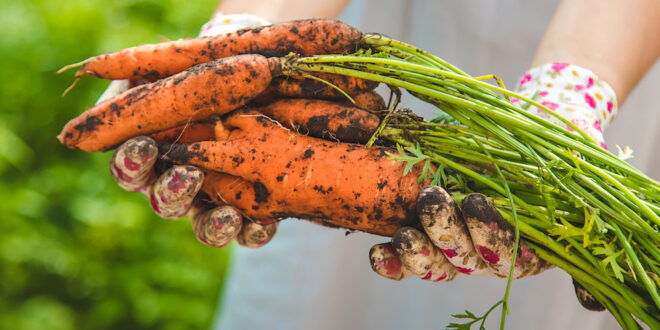
Winter can seem like downtime in the kitchen garden, but if you use it to diagnose problems with the fruit and veg you’re currently harvesting, it can make all the difference to how your edibles perform this time next year. Below, we take a look at some of the more common problems affecting two mainstays of the winter garden: carrots and parsnips, and diagnose possible causes.
Forked carrots and parsnips
Winter weather is not the cause of forked root vegetables. The problem began way back in spring or summer. Most vegetables have hundreds of fine roots that reach out horizontally through the ground in search of nutrients. Carrots and parsnips, on the other hand, are ‘tap’ roots i.e. one long, wide root built to penetrate the ground in search of deep-down, hard-to-find nutrients. However, like most living things, if there’s an easier way to find food, your carrots and parsnips will take it! Which is why, back in spring, if you added nutrients (such as compost and fertilizer) to your winter root bed, your carrots and parsnips will have grown in all directions (forked out) to ‘devour’ them. Fortunately, the problem is easily solved. When you prepare your carrot and parsnip bed this coming spring, skip the nutrients, and sow these vegetables into a garden that was used to grow a well-fed crop in the previous spring or summer.
If your carrots and parsnips are forked, this problem may also have developed in summer, due to a poor watering routine. Just as these root vegetables are forced to grow deep and straight in search of hard-to-find nutrients, they also ‘dig deep’ in search of moisture. When conditions are dry, and we water the garden carelessly, carrots and parsnips take the easy option and grow in all directions to take advantage of the moisture in the upper layers of the soil. Unless it is absolutely essential (i.e. your carrot and parsnip tops are browning off because of drought conditions) refrain from watering. If you must provide moisture, water long and deep so that the moisture seeps right down to the base of the tap root.
Forked roots in carrots and parsnips can also be the result of a poorly tilled bed. Carrots and parsnips are hardy, but they can’t grow through rocks and stones. They will also ‘jib’ at having to push through a hard pan (a dense layer of material such as hard clay). When the roots have to grow ‘around’ obstacles, they will fork out or become misshapen. When preparing a bed for winter root vegetables, dig deep to loosen the soil to a depth that is twice that of a spade blade, and remove rocks, stones, and sticks as you go.
Short roots
Sometimes, carrots and parsnips don’t perform well, resulting in short, stunted root growth. The reasons are many, but one of the most common is an attack by sap-sucking insect pests. During the active growing period of spring and summer, overly dry or wet and cold conditions weaken the young carrot and parsnip plants, slowing down their growth. Weak plants are a magnet for sap sucking insects that are able to more easily pierce weakened foliage with their mouth parts. Damaged foliage is unlikely to recover sufficiently to provide the roots beneath with food, resulting in a stunted harvest. To prevent insect attack in adverse weather conditions, provide young carrot and parsnip plants with a mesh crop cover held down securely at the sides. If attack has already started, spray the rows twice weekly, for a fortnight, with the following (completely cooled) DIY mix: half a teaspoon of hard bathroom hand soap dissolved in one litre of boiling water.
Short roots can also be the result of shading from other plants. The roots of nearby trees or shrubs may invade your vegetable beds, depriving your carrot and parsnips of nutrients. Be sure to choose a sunny, open bed for your carrots and parsnips, well away from trees or shrubs.
Wireworm damage
Wireworms are the larvae of click beetles which lay their edges in the soil of your garden bed. The larvae live in the soil for up to 6 years, feeding on the roots of plants until the insects are ready to pupate. Wireworm damage is not always significant in the case of carrots and parsnips. However, danger also comes from disease which enters the carrot and parsnips via the damage the wireworms have caused. Where you find rotten sections in carrots and parsnips, you are also likely to find wireworms. The best way to avoid and manage wireworm is practicing crop rotation. Crops such as lettuce, garlic, shallots, leeks, and brassica are unlikely to attract wireworm. Growing your carrots and parsnips in beds previously occupied by these vegetables for several seasons, your root crop may be safer from wireworm attack.
By diagnosing your carrots and parsnips (and other vegetables) now, you can improve the coming year’s crop and have a better-than-ever harvest next winter!
Join the Discussion
Type out your comment here:
You must be logged in to post a comment.