





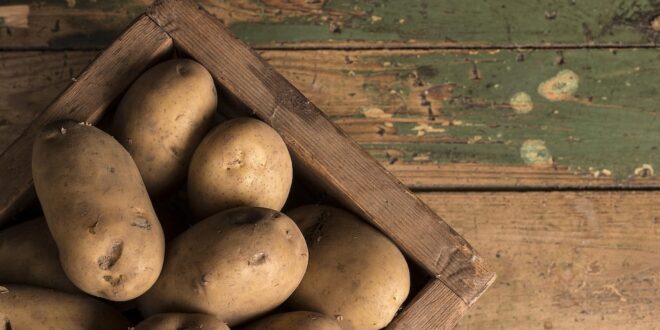
It’s ‘grow-a-potato-in-a-bucket’ time of year, again, and if there’s one challenge that gets home growers enthused, it’s this one! In fact, this uniquely exciting method of growing our favourite veg even inspires community’s around the country to organise fetes, festivals, and competitions to help make it happen! Along with the entry forms come numerous tips and tricks to increase tuber size, harvest weight, and even the number of spuds resulting from a single seed potato. Yet, despite putting in their best effort, many bucket-potato growers are left confused, disappointed, and often out-of-pocket – so what’s going on? We dug into the subject to bring you the low-down on this national obsession!
Undisputed
Secrets aside, one thing is certain – the kind of growing medium potatoes prefer, including those grown in buckets. Spuds will perform best when grown in a damp (not moist), light, humus-rich, free-draining, mature compost. One free of impediments such as sticks and stones. If you’re adding inorganic fertilizer, choose one with the numbers 6.10.10. This gives the developing spuds nitrogen (but not so much the tops grow at the expense of tubers), plus sufficient potassium to help draw nutrients and moisture up through the plant.
Container questions
For years, car tyres were favoured as a way to contain growing spuds but, thanks to science, we know it’s not safe to do this. Tyres leach toxins into the soil as they degrade, releasing chemicals including heavy metals. But there’s another reason why tyres have fallen out of ‘fashion:’ – they’re black! Soil in dark containers tends to heat up more quickly than in a lighter coloured container. While spud foliage welcomes the sun, spud roots prefer a cooler root zone. (It pays to think: ‘head in the sun, roots in the shade,’ to remind you of this). So, when choosing to grow a potato in a container, go with a lighter coloured bucket.
Earthing up – save yourself the bother!
Bucket-potato growers love nothing better than the thought of gaining an increased yield from a single spud. To do this (often encouraged by highly exaggerated claims and AI-engineered photos), they follow guidelines to plant their seed spud in the lower third of their bucket. The aim is then to add growing medium to the bucket as the potato shoot, followed by the stem, pushes up towards the light. The thinking behind this is, as the stem contacts the soil, more and more young potatoes will grow out from it. But the potato expert we talked to isn’t convinced. Developing potato tubers, he says, tend to grow at the same level the seed spud was planted. If any further tubers do branch off the stem at different levels, they tend to be small, and not worth the bother of earthing up. What’s more, he adds, earthing up simply uses up (often costly) growing medium that is serving little purpose.
Layer sowing
Some bucket-potato growers swear by planting up to 3 seed potatoes in a bucket, each at a different level. By doing this, they hope tubers will develop throughout the growing medium. But our spud expert tells us planting more than one seed potato in a bucket is a recipe for ‘crowding,’ something which can encourage poor air movement around the foliage, and therefore, fungal disease. Several developing potato plants, all drawing nutrients from the same limited supply in the bucket, can result in smaller tubers throughout the harvest.
What’s a bucket-grower to do?
When all the variables are taken into account, we’re left with some pretty straight-forward advice, and it’s this:
Half fill a light coloured bucket (with a drainage hole in its base) with the kind of growing medium suggested, above. Place your seed spud on top, followed by enough growing medium to come within a few centimetres of its rim. Add water, but only enough to moisten, not wet, the growing medium. Place the bucket where it will receive all-day sun. If the spot is particularly warm, shade the bucket, but not the developing potato foliage. If, at any stage, you see tubers protruding through soil, cover them with some growing medium.
It’s as simple as that – but if you’re still craving a ‘magic’ tip – try this one: Early potatoes have a more compact habit than main crop potatoes (which have a longer stem). Avoid broken stems and wind-damaged foliage by choosing early varieties of seed potato to sow in your bucket.
And with that, here’s wishing you the very best with your spud-in-a-bucket growing!

Join the Discussion
Type out your comment here:
You must be logged in to post a comment.