




By Dr Barbara Sumner
When we talk about adoption, we tend to talk about love. About families formed through extraordinary circumstances, about children given opportunities, and about the generosity of those who open their homes and hearts. This story is real and matters, but it is not the whole story, and for the person at its centre, the parts we leave out matter enormously.
More than 100,000 New Zealanders are adopted. In 1997, 3.2 per cent of the New Zealand population had been adopted. Approximately 16 per cent of the New Zealand population has a direct connection to adoption, including grandparents, siblings, etc. It is clear a large proportion of Aotearoa is touched by this practice.
Adoption transfers all the rights and responsibilities of parenthood from one set of adults to another, but it does far more. It assigns a new, permanent, non-genetic identity to the adopted person without their consent. The adopted person is issued a new birth certificate listing the adoptive parents as the people who gave birth, with no indication this is a legal fabrication.
New Zealand passed the Adult Adoption Information Act in 1985, allowing adopted adults to apply for a copy of their original birth certificate. It was hailed as a significant step towards the right to an authentic identity, but the law included contact vetoes. A mother could deny her child the very biographical knowledge she herself lives by, including the simple facts of origin most people never have to consider. In effect, an adopted adult’s right to know their own story remains conditional on another person’s consent.
Yet those who finally obtain their “original” birth certificate discover it has been quietly amended and endorsed with the adoptive parents’ details, as if they had been there all along. As Internal Affairs was quick to point out, this is to ensure the adopted person does not use it to create a false identity. They also add, an original birth certificate is “essentially ornamental”, while the adoption “birth” certificate is known as a “legal fiction”.
All other adoption records, of which there are many, remain permanently sealed and accessible only by court order, itself an avenue so narrow as to be nearly theoretical. For many adopted adults, questions of identity: who they are, where they come from, and what records exist about their earliest life, are central to their lives. Discovering the state holds copious records on them they are not entitled to can be a significant moment.
Research consistently shows adopted individuals are more likely to experience identity-related challenges. In Aotearoa, despite 71 years of the social experiment known as closed stranger adoption, no outcome studies have been conducted.
Internationally, the most recent and comprehensive survey examined the mental health issues faced by adopted adults and first mothers. The results indicate adoption has lasting adverse effects, with adopted adults and first mothers significantly more likely than their peers to attempt suicide (35 and 37.7 times, respectively), abuse alcohol, display hypersexual behaviours, and restrict their eating. Women who lose a child to adoption have a lower life expectancy and are more likely to die by suicide than women who did not lose their children to adoption. Adopted adults frequently struggle with their identity and sense of belonging, and with a range of negative behaviours.[1]
This is not a reflection on the quality of the adoptive family. It reflects the human need to understand one’s own story, including the parts which occurred before memory begins, and to belong to one’s own family.
For those who grew up in closed adoptions, the absence of medical history, ethnic heritage, and biological context can create what some call genealogical bewilderment: a gap in self-knowledge that those raised in their family of origin rarely have to confront. Access to records does not solve everything, but it closes a gap that should never have been opened.
Often, the official response to negative statistics on adoption is to promote the advent of open adoption. While this is presented as a genuine improvement, such arrangements are not legally enforceable. It is understood the promise can be used to entice a mother to relinquish her rights. They rely on adopters’ good faith, and it is not unknown for adopters to withdraw contact. Open adoption does not include open records or grant any form of autonomy to the adopted person.
If you are considering adoption, it is worth noting a New Zealand Law Commission report opined adoption legislation reflects principles of property and contract law rather than those of family law. Guardianship can provide safety, stability, and love without requiring a person to permanently forfeit their identity to receive it.
If you are an adopted person navigating these questions, your right to know your own story is legitimate. In the most fundamental sense, the records about your birth belong to you.
Human adoption is centred on a narrative of rescue and redemption, yet it is far more complex. For the infant, all adoption is forced. We all arrive with ancestors, extended family, and deep-rooted stories. Honouring our history, in law and in family life, and understanding the impacts and implications of human adoption are the least we can do.
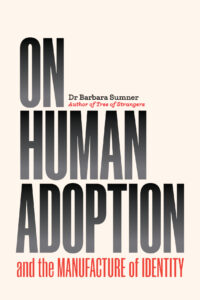 Dr Barbara Sumner is the author of the memoir Tree of Strangers and the historical fiction The Gallows Bird. Her newly released ON HUMAN ADOPTION and the Manufacture of Identity expands on her PhD research on the structures, functions and purpose of adoption in Aotearoa. Her Substack, Adoptology – Adoption Deconstructed, examines adoption law, policy, and lived experience.
Join the Discussion
Type out your comment here:
You must be logged in to post a comment.