





Uncover the wonders of Southeast Asia on our bestselling Angkor to the Bay tour. Explore Cambodia’s majestic Angkor Wat, serene Tonle Sap villages, and vibrant Phnom Penh. Then journey through Vietnam, from the buzzing streets of Saigon and the Cu Chi Tunnels to the ancient charm of Hoi An, imperial Hue, and cultural Hanoi.
Cruise the breathtaking waters of Halong Bay for an unforgettable finale. Perfect for travellers seeking the ultimate Vietnam and Cambodia tour, combining history, culture, and stunning landscapes.
*Flights and meals included. Terms and conditions apply. Subject to availability. Solo departures available

Itinerary
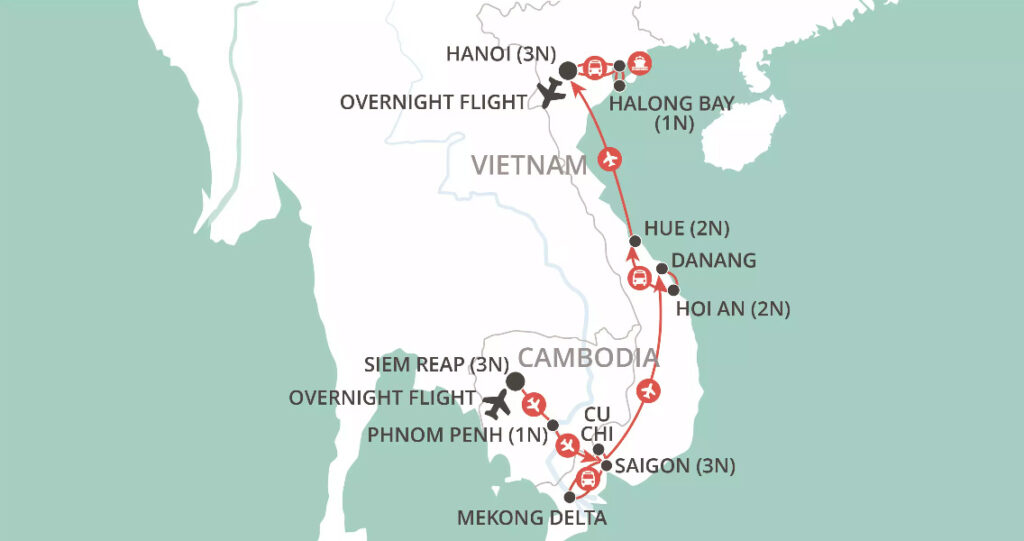
Fly to Siem Reap. You will be met at Siem Reap in the arrival’s hall by your Local Guide or National Escort from Wendy Wu Tours. Together with all other group members who may be arriving at a similar time travel to your hotel.
Siem Reap is a bustling tourist destination due to its proximity to both the ancient Khmer national capital city of Angkor as well as Tonle Sap Lake. Angkor Wat is one of the main attractions and is the world’s largest religious monument, in addition to being the spiritual and cultural heart of Cambodia. This huge complex of palaces and temples were built on the sprawling alluvial plain to the north of Tonle Sap.
This morning, explore the less-visited Beng Mealea, a mysterious sandstone temple reclaimed by the Cambodian jungle. Dating back some nine centuries and built originally as a Hindu temple to Vishnu, its ruins are wreathed in vines and colossal tree roots now swallow its stones. Explore on foot via the wooden walkways and bridges around the site.
Continue on to Tonle Sap. This afternoon’s excursions are seasonal. In the high-water season (Aug to Feb), you will travel to Kompong Khleang, a unique village on stilts, while in the low-water season (Mar to Jul) you will visit Chong Kneas floating village.
Return to Siem Reap, with a visit to SATCHA, an organisation working alongside local craftsmen to create high-end and traditional Cambodian arts and crafts. This evening, enjoy a traditional Apsara dance performance at dinner.
About Beng Mealea
Dating from the 11th – 12th century, this sprawling temple spans over a square kilometre. Largely overrun by jungle vegetation and constructed in a distinctly Angkorian style, Beng Mealea dates to approximately the same period as Angkor Wat, and may even have served as its ‘prototype’.
Spanning from the 9th to 15th century, the Angkor complex was the capital of the thriving Khmer Empire, and home to over 1,000 temples. Begin at the city of Angkor Thom, built by Jayavarman VII. Here, sights include the enigmatic Bayon, the Elephant Terrace and the Terrace of the Leper King. One of the most evocative ruins here is to the temple of Ta Prohm, enveloped in a labyrinth of jungle.
This afternoon is devoted to the fascinating and awe-inspiring Angkor Wat, the largest religious monument in the world and nationally considered to be Cambodia’s spiritual heart. Later, relax on board a boat and view the sunset on Angkor Thom’s moat.
Please be aware the Central Tower of the Wat complex is closed on Buddhist holidays, and on all other days has a limited number of visitors allowed at any given time, under UNESCO regulations. If you wish to visit this tower, you will be required to wait in the queue alongside all other visitors. The ability to do this will be determined upon the groups’ schedule. If you choose to climb at any site, you must be able to climb and descend without assistance.
Angkor Thom – This was the last capital of the Khmer empire, established by Buddhist King Jayavarman VII in the 12th century. This walled city, covering an area of 9 square kilometres, is flanked by a row of 54 stone figures on each side, which leads you through a 23-metre imposing stone entrance gate to the various temples inside.
Bayon – A rich, late 12th century state temple at the centre of Angkor Thom. Its beautifully crafted central towers are decorated with four opposing faces representing Jayavarman. Bayon’s stone galleries display extraordinary bas-reliefs incorporating over 11,000 figures.
Elephant Terrace and Terrace of the Leper King – The Elephant Terrace is named for the carved elephant parade on its eastern side. Giant viewing platforms used for public ceremonies, served as a base for the King’s grand audience hall. To the north is the Terrace of the Leper King, named for a statue found at the platform.
Ta Prohm – One of Angkor Thom’s most atmospheric ruins, swallowed by the roots of the jungle, Ta Prohm has several towers, closed courtyards and narrow corridors to explore. Originally dedicated to Sri Jayarajacudamani, the mother of the king who established Angkor Thom, it was made famous by the film Tomb Raider.
Angkor Wat – This 12th century temple complex is the largest religious monument in the world. Surrounded by a 190-metre moat and taking 30 years to build, Angkor Wat showcases the Khmer civilisation at its grandest, and was designed to represent Mt Meru, the Hindu equivalent of Mt Olympus. With its fascinating decorative flourishes, extensive bas-relief and multiple tiers, it is the best-preserved temple within the complex. Angkor temples were traditionally dedicated to the Hindu god Shiva, but Angkor Wat broke tradition in that it was originally dedicated to Vishnu, and was later reworked as a Buddhist temple. The silhouette on the flag of Cambodia is that of Angkor Wat, and it is recognised as Cambodia’s spiritual and cultural heart.
Depart Siem Reap and fly 1 hour to Phnom Penh, a city of attractive boulevards. Visit the Cambodian Royal Palace and the opulent Silver Pagoda before travelling to the National Museum with extensive artefacts on display, sightseeing today will involve approximately 3 hours on foot.
Phnom Penh – The capital of the Kingdom of Cambodia is built around four river arms formed by a sharp curve in the Mekong River near the junctions of the Bassac and the Tonle Sap tributaries. This charming city has a pleasant blend of oriental and colonial architecture, but reminders of a troubled past are also evident.
The Royal Palace – Built in 1866 by the French these ornate buildings are the official residence of the reigning Cambodian royal family and King Sihamoni. View the Throne Hall and Silver Pagoda.
Silver Pagoda – This concrete and marble structure includes a floor with over 5,000 silver tiles each weighing 1kg. Famous artefacts include a 90kg solid gold Buddha made in 1907 and an Emerald Buddha said to be made of baccarat crystal.
National Museum – Housing the world’s finest collection of Khmer pottery, bronzes and sculptures dating from the 4th century.
Visit Tuol Sleng Genocide Museum for a harrowing insight into Cambodia’s tumultuous past. This sombre museum was the site of the Khmer Rouge Security Prison 21, a torture and execution centre built within a former secondary school during the regime of Pol Pot. It now stands as a museum, commemorating the atrocities that occurred here. Many people find it quite confronting and emotional; you will be given time to explore on your own.
Later, continue to the hilltop temple of Wat Phnom at the heart of the city before your 1-hour flight to Ho Chi Minh City (Saigon), where you will meet your Vietnamese National Escort.
Tuol Sleng Museum – This former school was used by the Khmer Rouge as a detention and torture centre in the late 1970s. Today this building houses paintings and photographs of the victims. You can see the crude cells built in the classrooms and the torture devices used to extract confessions by the regime.
Wat Phnom – A hilltop temple, rebuilt on multiple occasions since its original version in the late fourth century. The walls within the sanctuaries are covered in murals, chiefly telling the stories of the Buddha. Locals flock here to pray for good luck and success.
Confront the reality of guerrilla warfare at the Cu Chi Tunnels. The cramped tunnels were central to a few of the war’s strategic operations, including the famous Tet Offensive, and they did not escape damage. American B52 bombers dropped hundreds of missiles leaving huge tell-tale craters behind.
The Cu Chi experience can be emotional for some visitors, but it offers a fascinating window into the hardship and traumas of war. Sightseeing here involves 2 hours on foot on uneven mud paths through the bush and, if you choose, crawling through some of the tunnels.
Continue the day with further sightseeing at the Reunification Palace and the chilling War Remnants Museum, before finishing at the Ben Thanh Markets.
Saigon – Formally renamed Ho Chi Minh City, but still locally known by its older name of Saigon, this exuberant city is driving Vietnam forward into the modern world, but is also a treasure trove of fascinating heritage.
It was a major base of the American military during the Vietnam War and was the seat of the South Vietnam government until the events that led to the country’s reunification. Today, the old mixes seamlessly with the new and you can wander through timeless alleys to incense-infused temples before catching up with the present in designer malls beneath sleek skyscrapers.
Cu Chi – The tunnels of Cu Chi are an immense network of connecting underground tunnels located in the Cu Chi district of Ho Chi Minh City (Saigon), Vietnam, and are part of a much larger network of tunnels that underlie much of the country. The Cu Chi tunnels were the location of several military campaigns during the Vietnam War and were the Viet Cong’s base of operations for the Tet Offensive in 1968. The tunnels were used by Viet Cong soldiers as hiding spots during combat, as well as serving as communication and supply routes, hospitals, food and weapon caches and living quarters for numerous North Vietnamese fighters. The tunnel systems were of great importance to the Viet Cong in their resistance to American forces and helped to counter the growing American military effort.
Reunification Palace – Built on the site of the former Norodom Palace, is a landmark in Ho Chi Minh City, Vietnam. It was designed by architect Ngô Viết Thụ and was the home and workplace of the President of South Vietnam during the Vietnam War. It was the site of the end of the Vietnam War during the Fall of Saigon on 30th April 1975, when a North Vietnamese Army tank crashed through its gates.
War Remnants Museum – Comprised of numerous buildings displaying military equipment, photographs and artefacts relating to the Vietnam War from 1961-1975. This museum illustrates a harrowing period in this nation’s history.
Drive two and a half hours down to the picturesque province of Ben Tre situated along the mighty Mekong. This area is known as the ‘Rice Basket of Vietnam’, because its rich and fertile lands produce huge amounts of rice, coconuts, vegetables and tropical fruit.
Spend the day exploring, travelling by motorboat between the islands and changing to smaller paddleboats in the canals. Sightseeing involves hopping on and off these boats, often on unsteady and slippery surfaces, sometimes without handrails or assistance. Return to Saigon this afternoon.
Mekong Delta – Although primarily rural, the Mekong Delta is a densely populated area where life progresses around its fertile banks. The Mekong Delta is the 12th longest river in the world, and people live, trade, travel and go to school on the riverbanks.
Explore modern-day Saigon, with its heady mix of local culture and colonial influences. See the Notre Dame Cathedral, the Central Post Office and the beautiful Thien Hau Pagoda.
Transfer to the airport for your 1 hour 20 minute flight to Da Nang Airport. From here, transfer 45 minutes to your hotel in Hoi An and enjoy the rest of the day at leisure.
Please note: The Notre Dame Cathedral will be under renovation until further notice. During this time we are unable to enter the Cathedral; however, it can be viewed from the outside.
Notre Dame Cathedral – Influenced by French design and built between 1863 and 1880, the red brick exterior and 60-metre bell towers overlook downtown Saigon.
Central Post Office – Located next to the Notre-Dame Cathedral. The Central Post Office building was constructed in the late 19th century. It counts Gothic, Renaissance and French influences and was designed by Auguste Henri Vildieu and Alfred Foulhoux but is often erroneously credited as being the work of Gustave Eiffel.
Thien Hau Pagoda – Located in Cholon, the Chinatown of Saigon this beautiful 19th Century Pagoda is dedicated to the Goddess of the sea.
This morning, visit a local community farming project just outside of Hoi An – Tra Que village where the community has come together to create a large vegetable farm. Learn the traditional methods the farmers use to plant, fertilise and harvest the crop, then try your hand at raking the ground and sowing seeds.
This afternoon, enjoy a walking tour of the narrow and ancient streets of this charming town. Visit one of Hoi An’s oldest homes, built over 200 years ago and still occupied by the descendants of the merchant family that originally built it.
Visit the traditional Hoi An Market, the Quan Cong Chinese Temple and the Japanese Covered Bridge. Stop at the Reaching Out Tea House to experience the social enterprise work happening here.
Hoi An – Perhaps more than any other place in Vietnam, Hoi An retains the feel of centuries past. Once known as Faifo, Hoi An was an influential port along the Silk Road. For over 500 years, merchants from China, Japan, France and Portugal settled in the prosperous town, resulting in a distinctive blend of culture.
Japanese Covered Bridge – First constructed in the 1590s to link the Japanese and Chinese quarters of the town. This iconic pink hued bridge has been restored to its former splendour.
Reaching Out Tea House – Provides opportunities and meaningful employment for people with disabilities to learn new skills. In the Tea House, you will experience a peaceful atmosphere allowing you to embrace the traditional Vietnamese service from the staff with speech and hearing impairments. Try the locally grown products and sip on tea and coffee as you enjoy the calm and quiet atmosphere of the Tea House.
Today, drive approximately 4 hours to Hue, this journey will take you over the scenic Hai Van Pass. Hue is the epitome of Vietnam’s dynamic past and considered a scholarly city. Upon arrival, visit the Thien Mu Pagoda and take a cruise on the Perfume River.
Hue – Having been the imperial capital from 1802 until 1945 after the last emperor abdicated; Hue is still regarded as the centre of Vietnam’s culture and religion. The city is dominated by the Imperial Citadel modelled on the Forbidden City in China. There are many wonderful pagodas and temples of high significance, and it contains the Grand Tombs of the Nguyen Emperors.
Thien Mu Pagoda – This seven-storey octagonal tower built on a hillock, overlooking the Perfume River is Hue’s oldest and most beautiful pagoda. Wander the grounds where bonsai, ponds and the smell of incense set a peaceful backdrop.
This morning, transfer to the tomb of Emperor Khai Dinh. Admire the unusual combination of architecture that blends a traditional Chinese past with a modern Western future. Then continue to Minh Mang Tomb to explore the opulent and exotic resting place laid out in formal Chinese style.
Afterwards, move on to a beautiful old maison that has been transformed to Truc Chi – an art space and workshop by a team of enthusiastic young artists. Learn more about Truc Chi and have the chance to buy their hand-made products (passport covers, fans or candle boxes made from bamboo pulp) to bring back home as gifts for your friends and family if you like.
After lunch, visit the imposing Imperial Citadel and Forbidden Purple City.
Imperial Citadel – A walled fortress accompanied by cannons, artilleries and surrounded by a moat for protection. Inside the Citadel are numerous gates, courtyards and the Forbidden Purple City.
Forbidden Purple City – Constructed for personal use by the Imperial family, their concubines and eunuchs. This royal structure is still being restored many years after the destruction caused by street fighting and bombing during the American war in Vietnam. Wander the grounds and foundations whilst viewing the remaining woodwork and architecture.
After breakfast, fly 1 hour and 20 minutes to the charming city of Hanoi where you will check into your hotel.
This afternoon, take a cyclo tour of Hanoi’s Old Quarter. Each cyclo takes one passenger and is operated by a cycle driver behind the carriage. Wrap up your ride with a strong Vietnamese coffee at a café overlooking Hoan Kiem Lake – an important symbol of Vietnamese folklore.
Hanoi – With a population of approximately four million, Hanoi is a charming and richly historic city of lakes, shaded boulevards and leafy open parks. The centre is an architectural museum piece housing groups of ochre-coloured buildings holding the air of provincial French towns of the 1930s, a “Paris of the Orient” as people have called it.
Hanoi Old Quarter – A maze of streets weaving through Hanoi and dating back to the 13th century. Each street specialises in merchants and artisans selling their wares of silk, silver, wood and more.
Drive around 2 and a half hours today from Hanoi to Halong, where you will take an overnight cruise to the farmost corners of the bay by boat. There is usually a crowd of boats at the docks; however, the cruise itself will be scenic and relaxing.
Boarding your boat could involve navigating your way over and through other boats, moored between it and the dock, sometimes without handrails, ladders or assistance from staff.
The boat has an enclosed dining area and an open area on the upper deck. Enjoy lunch onboard as you cruise out into the bay, stopping to anchor for an afternoon of activities (which are subject to change due to cruise selection and weather conditions). Sightseeing includes visiting underground caves on the islands, which require climbing up and down steps inside and outside of the caves. End the day on deck with a drink in hand to watch the sunset over the bay followed by a freshly prepared dinner, before retiring to your cabin for the night.
Please note – You will need to pack a smaller overnight bag for your trip to Halong Bay. Main luggage will be left in safe storage at the hotel in Hanoi and picked up your return.
Please note: Weather conditions such as mist, fog, wind, rain and storms may delay the departure time of your cruise, or in some cases your cruise may be cancelled. Notifications of any delays or cancellations may not be known until your group’s arrival in Halong Bay. If your cruise is cancelled after your arrival in Halong Bay, you will have lunch in Halong City and return to Hanoi. If notification of the cruise cancellation is given prior to your departure for Halong Bay an alternative day trip will be arranged to Hoa Lu and Tam Coc or ‘Halong Bay on Land’, an area located approximately 2 hours from Hanoi. Our guides will make every effort to inform the group at the earliest possible moment should there be any itinerary changes
Halong Bay – Compared to the landscape of the limestone islets of Guilin in China and Krabi in southern Thailand, Halong Bay shares a common border with China in the north and harbours some of the most stunning scenery in Vietnam. Unique rock sculptures jut out dramatically from the clear emerald waters of the Gulf of Tonkin and numerous grottoes have created an enchanting, timeless world, looking out onto the horizon with the sails of the junks and sampans completing the picture.
Spend the morning sailing through Halong Bay. After an early lunch (or brunch meal) disembark your cruise and return to Hanoi. This evening, attend The Quintessence of Tonkin show, an artistic open-air performance celebrating the rich history of northern Vietnam.
Discover the sights of Hanoi today. First stop will be Ba Dinh Square, then the Ho Chi Minh Quarter and pass Ho Chi Minh’s Mausoleum, followed by the Humble House on Stilts and the One Pillar Pagoda. Next, drive to the serene Temple of Literature, Hanoi’s first university.
Any time before your flight is free at your leisure today. You will be transferred from the hotel to the airport, according to the departure time of your international flight. Fly to New Zealand, arriving home the same or following day.
Late check-out is not included in this tour.
Highlights
- Be inspired by spectacular Angkor temples
- Experience local life in Tonle Sap
- Explore the fascinating Cu Chi Tunnels
- Visit captivating Phnom Penh
- Try traditional farming techniques in Hoi An
- Marvel at Hue's Imperial Citadel
- Stroll through Hanoi's alleyways
- Cruise the magnificent Halong Bay
What's Included
- Return international economy flights, taxes and current fuel surcharges (unless a land only option is selected)
- All accommodation
- All meals as specified
- All sightseeing and entrance fees
- All transportation and transfers
- English speaking National Escorts
- Vietnam & Cambodia visa fees for New Zealand passport holders
- Comprehensive travel guides
- Safe and secure with IATA
Terms & Conditions
Prices include airline fuel surcharge and taxes. Correct as of 31 July 2025, subject to change.
Depending on airline schedules, you may depart and/or arrive on Day 2. Extra nights’ accommodation (pre or post tour) or stopovers may be required at an additional cost.
Customary tipping amount of approximately US$105pp is paid locally in Vietnam.
Based on departures from Auckland
Departures from other cities and flight upgrades available upon request
Single supplement from $1,300 (does not apply to solo exclusive departures)
Wendy Wu intend to adhere to the day-to-day itinerary as printed; however, the order of events or sightseeing may change as they look to improve their tours, or as dictated by local conditions. In these circumstances, we will endeavour to make the best possible arrangements whilst maintaining the integrity of your trip.
Personal Expense – You will need to take some extra money to cover drinks, laundry and souvenirs, plus any additional sightseeing that may be offered to you.
VISAS:
Vietnam and Cambodia – Entry visas are required by all visitors. Wendy Wu Tours Visa Department can assist you with the process of obtaining a visa. We will supply you with all paperwork if applicable and submit the visa application on your behalf. Please be advised that your passport must have at least six months validity left on it when you arrive back into New Zealand.
Please note the visa procedures and requirements may change at any time. These changes are often made by the relevant embassy or consulate; Wendy Wu Tours acts as a third party and has no influence on the process of a visa. Currently a visa is required for New Zealand Passport holders. Your travel consultant will inform you if any changes are applicable prior to your departure.
Cambodia Entry Requirement – Effective 01 July 2024, all guests travelling to Cambodia must complete a mandatory online e-immigration application within 7 days prior to their arrival. You may complete the form via the mobile phone app called Cambodia e-Arrival (CeA), or the form can be completed online at https://arrival.gov.kh/. The app and the registration process are free of charge.
LUGGAGE:
All travellers are limited to two items of luggage each; a suitcase with a maximum weight of 20kg and one piece of hand luggage with a maximum weight of five kilograms. It is essential that your luggage is lockable.
VACCINATIONS AND YOUR HEALTH:
We recommend that you contact either your doctor or local Health Centre for advice on vaccinations and travel health. Safe Travel has a comprehensive website that you may also find useful www.safetravel.govt.nz
APPROPRIATE DRESS:
When visiting temples or mosques, both men and women should dress in conservative, non-revealing clothing. Full-length trousers with a shirt or t-shirt for men; and pants or skirts well below the knee with a top that covers the shoulders and upper arms for women. Women might also consider carrying a ‘modesty shawl’ in their daypack – this could be a sarong or light scarf – which they can wear over their shoulders and heads to feel more comfortable while sightseeing at mosques.
Religious sites and homes throughout Southeast Asia – for Hindus, Muslims or Buddhists to name a few – require all visitors to remove their shoes to enter. Even if you then need to walk outdoors, over hot or rough ground, you will not be allowed to wear shoes. You will often find shoe storage rooms near the entrance of a site where it is customary to leave your shoes near the entrance. Occasionally there are ‘shoe minders’ who will offer to keep your shoes safe for a ‘tip’ – this is not compulsory, so each customer can choose to tip for this service or not. If you do not want to remove your shoes, you will have to remain outside.