





People often ask me why I walk.
They expect a simple answer: fitness, adventure, fresh air. And yes, there is all of that, but the real reason is more complicated – and more hopeful – especially as we get older and life begins to narrow in ways we didn’t expect.
A few years ago, I was diagnosed with early-onset Parkinson’s. Like many people who receive a life-changing diagnosis, my first response wasn’t physical, but mental. I wondered how long I would be able to keep doing the things I loved. How long I would be independent. How long my body would keep cooperating. I was afraid of what lay ahead.
Parkinson’s is often thought of as a disease of movement, but long before the body stiffens or trembles, the mind begins to shrink the future. You start imagining what might go wrong. What you might lose. What will no longer be possible. I was afraid of the unknown.
That narrowing – of possibility, of confidence, of joy – is something many of us experience as we age, whether through illness, injury, redundancy, bereavement, or simply the realisation time is no longer infinite.
Walking, for me, became the antidote.
Not just walking around the block – though that matters too – but long, purposeful walking. Pilgrimage walking. The kind where you shoulder a pack, set out at dawn, and trust you’ll work out the rest as you go.
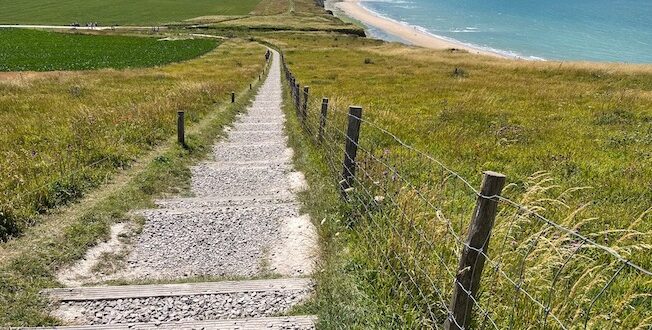
In 2024, I walked more than 2,400 kilometres from Canterbury to Rome along the ancient Via Francigena, crossing England, France, Switzerland and Italy on foot. It sounds heroic on paper, but the reality is more ordinary: sore feet, early mornings, empty stretches of countryside, long days alone with your thoughts.
And that’s exactly why it works.
The first third of a long pilgrimage is mentally demanding. The terrain is often easy, but the solitude is not. In northern France, I walked for weeks through flat farmland and depopulated villages, sometimes not seeing another pilgrim all day. The path is considered ‘boring’ by many, and most people skip it entirely.
Howver, solitude has a way of stripping things back. With nothing to distract you, you are forced to meet yourself as you are – anxious thoughts, fears, doubts and all. Walking day after day teaches you something simple and powerful: you don’t need to solve everything at once. You only need to take the next step.
This lesson is gold if you’re living with Parkinson’s – or with any form of uncertainty. Parkinson’s erodes dopamine, the chemical linked to motivation and optimism. Walking restores it naturally, through movement, decision-making and purpose. Each day brings small choices: when to stop, where to eat, whether to keep going. Each choice reinforces agency. Each step says, I am still moving forward.
Somewhere along the way, I began thinking about a black panther.
It may sound strange, but the image kept returning – a quiet, powerful presence moving confidently through shadow. As a child, I used to dream of being chased by a panther, terrified not of being caught, I realise now, but of slowing down. Years later, the metaphor makes sense.
The panther is not a creature of the spotlight. It sees in the dark. It trusts its instincts. It moves with grace rather than force. Once, it symbolised fear for me; now it feels like a guide – a reminder darkness is not something to be avoided, but something we can learn to move through.
That idea stayed with me as the pilgrimage shifted into its physical middle stage – crossing mountains, climbing passes, descending into valleys. This is where the body is tested. Parkinson’s thrives on hesitation and freezing; walking retrains rhythm and flow. The repetition of movement – step after step – seems to teach the brain new pathways. On the trail, my symptoms softened. I felt more fluid, more present, more myself.
In Siena, I came across a bronze statue of a panther with an inscription that stopped me in my tracks: My momentum overcomes all obstacles. It became my mantra. Not speed. Not force. Momentum. Keep moving, however slowly. Don’t stop.
By the final third of the journey, something subtle changed again. The walking became effortless. The mind grew quiet. What emerged was a sense of meaning – a lightness I hadn’t expected.
In a small Italian village, a hospitalero told me there were 99 churches in nearby Lucca. When I asked jokingly about the hundredth, he looked me in the eye and said, ‘You are the hundredth church.’
His comment landed deeply. The light we look for — healing, peace, purpose — isn’t always out there waiting to be found. It’s already within us, carried forward one step at a time.
That idea echoes a line from the Bible: ‘You are the light of the world.’ Not after everything is fixed. Not when life is easy. Now. Even – especially – when things feel uncertain.
Walking hasn’t cured my Parkinson’s. But it has changed my relationship with it. It has kept me supple – mentally, physically and spiritually. It has taught me ageing, like pilgrimage, is not about avoiding darkness, but learning how to move through it with trust. It is in the unknown we learn and grow.
I now have a small tattoo of a panther in motion on my ankle — not as a decoration, but as a reminder. Keep going. Trust your instincts. Carry your own light.
If there’s one thing I’ve learned, it’s this: you don’t need to walk to Rome to begin. You just need to start where you are, step outside, and move.
One foot in front of the other.
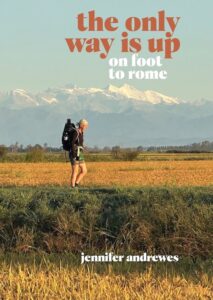 Article by Jennifer Andrewes. Read about her new book, the only way is up, here.
Join the Discussion
Type out your comment here:
You must be logged in to post a comment.