






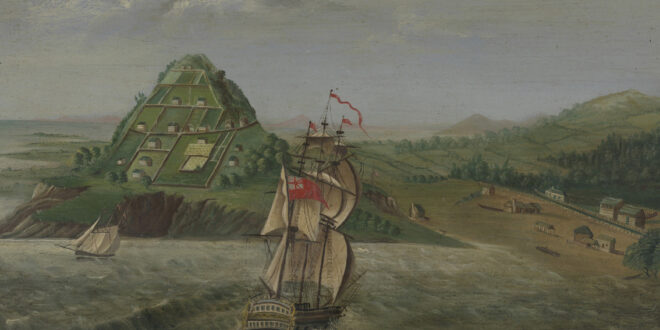
We’re excited to be giving away two copies of The Art of Colonisation by Paul Moon to our GrownUps members!
To be in the draw, simply make sure you’re a GrownUps member, signed up to our newsletter, and fill in your details at the bottom of the page.
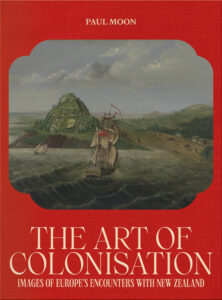 About The Art of Colonisation
Through Professor Paul Moon’s meticulous research, this stunning book of selected artworks, shows how imperial art became a form of colonisation.
Professor Paul Moon is one of New Zealand’s most prolific authors; his latest biography on photographer Ans Westra garnered glowing reviews. In this book, his meticulous research shows, through selected artworks, how imperial art became a form of colonisation by colour. He writes, ‘artists in New Zealand in the colonial era, not tied to a state vision, tried to flex their individual aesthetic and ideological perspectives.’
A spectacular production, both historically and aesthetically, with 20 short, fast-paced chapters. Artists include Holle, Sporing, Hodges, Earle, Tupaia, Heaphy, Watkins, Steele, and more.’
Author Note
‘I’ve spent three decades immersed in the history of New Zealand’s colonisation, and like other historians working in this field, have relied during this time overwhelmingly on the documentary record of the period.
Art is another form of record, though, which illuminates the process of colonisation in a very different way. Artists in New Zealand in the colonial era were generally not tied to a state vision of the colonial enterprise, and so their perspectives of imperialism are far more diverse. They depicted the country in several different ways thematically. There was New Zealand as an exotic landscape (with its equally exotic indigenous inhabitants), a new Eden, a place of agricultural potential, a country of botanical curiosities, a mysterious terrain to be explored, a location where embryonic signs of ‘civilisation’ were appearing, and a site of conquest (whether it be military, sexual, religious, or cultural).
Paintings were often the first trophies of European intrusion into New Zealand. They were a form of visual plunder, which left no mark on the scenes that they portrayed, but which whetted the appetite of some viewers for further intervention. Beyond this, art was a way of accumulating, classifying, codifying, and curating knowledge about the country’s indigenous people. It aided the process of placing the European understandings of the Māori world in a sort of intellectual specimen-drawer – one that could be opened and added to at any time, but that was firmly in the hands of those depositing information into it.
These approaches to the art portraying New Zealand’s colonisation offer at rich seam when it comes to exploring attitudes towards European intervention in the country. Examining these attitudes was a particularly compelling motive to write the book.’
About the Author
Professor Paul Moon holds a Bachelor of Arts degree in history and political studies, a Master of Philosophy degree with distinction, a Master of Arts degree with honours, a PhD, and a Doctor of Literature degree.
In 2003, he was elected as a Fellow of the Royal Historical Society at University College London, and is also a Fellow of the Royal Society of Arts.
He has written some 40 books on New Zealand, been a finalist in two international history awards, and has worked on several Waitangi Tribunal claims.
In 2002, he was appointed an Officer of the New Zealand Order of Merit for his services to education and historical research.
Paul Moon teaches at Auckland University of Technology, where he has been since 1993. He was born in New Zealand and educated in Auckland.
Not a member? Join now
Terms and conditions
You must be a GrownUps member and subscribed to our newsletter to be eligible to enter.
The competition closes on 4th March 2026. Winners will be notified via email by 5th March 2026.
It is your responsibility to provide a correct New Zealand postal address for prize delivery. GrownUps is not responsible for prizes sent to incorrect addresses.
Winners will be drawn at random by the GrownUps administration team.
GrownUps employees and their immediate families are not eligible to enter.
By entering, you agree to GrownUps using your name on social media as a winner of the competition.
One entry per household.
The prize is non-transferable and cannot be exchanged for cash or other items.
You must reside in New Zealand, as the prize can only be delivered within New Zealand.
You must be over 50 years of age to enter. Please ensure your membership details are up to date in your dashboard.

Join the Discussion
Type out your comment here:
You must be logged in to post a comment.