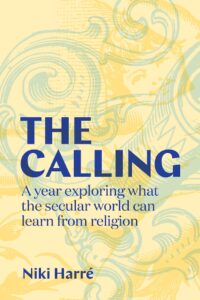
By Niki Harré
In 2021 I spent a year as a self-declared secular priest. I had three vows: simplicity, hospitality and pause; and offered services, ceremonies and personal conversations. I also attended a Christian church and immersed myself in Christian literature. My intention was to learn from religion while putting a God-free version of it into practice. I knew my plan was ambitious but considered it feasible, and I was just the person for the job.
As with the majority of New Zealanders, I’m atheist. Over the past few decades, the number of people affiliated with a religion in New Zealand has plummeted, with 52% of us indicating we had no religion in the 2023 national census. I’m one of the 52%, but I’ve long been attracted to practices encouraging us to look beyond our personal or narrow group interests and towards everyone and everything else. I knew these practices were at the heart of the major religions, including Christianity, the religion of my cultural heritage.
In my year as a secular priest, I was welcomed into a non-denominational, liberal, Christian community and deeply inspired by the treasure trove of Christian wisdom I encountered in books, podcasts and the interviews I conducted with Christian leaders. Over the course of the project, I developed a more nuanced sense of what it means to turn towards humility, reflection, the unknown, attentive listening, care for others, and awareness of the world as it is rather than as we wish it to be. I came to think of these qualities as a ‘religious orientation’ – aimed at realignment between people and between people and the natural world.
My services included blessings, a 10-minute provocation (talk), singing and time for individual and collective reflection. They were held on Sundays at 5pm in a community centre near my home and repeated online on Wednesday mornings. By the end of the project, I had delivered 17 pairs to a tiny community of people willing to come along for the ride – a ride that, for me at least, was bumpy. My first attempt to advertise my services was an invitation to 29 people I knew from community-based environmental groups. None of them responded, which made for a disconcerting start. Some friends objected strongly to my language, ‘Don’t call yourself a priest!’ one said. I realised many people aged 45+ had been raised in traditional religious families and actively rejected the faith of their early years. They were not interested in the dabbling of an upstart like me. Others did not want to be ‘talked at’ but sought an unmediated spirituality through, for example, immersion in the natural environment. However, enough people did attend and they seemed to appreciate the opportunity to listen to, reflect on and discuss ideas with people similarly seeking to deepen their contribution to our lives together.
When people asked how the year was going, I found myself saying everyone should try a year as something-or-other, if they can. I loved being constrained by my vows, particularly simplicity. I put together a uniform of grey and black clothes and was not allowed to buy anything non-essential. I could buy food and basic necessities such as washing powder and painkillers, and replace major items if they broke and couldn’t be repaired (none did). All other shopping — even browsing online — was out. And it was easy – so easy in fact, I almost forgot about the vow itself. Hospitality was more of a challenge as I’m naturally introverted, but I learnt to greet people when out and about, and be less rigid about sticking to my plan for the day or week, when others had needs or suggestions. Despite initial resistance to meditation, which I viewed as physically and mentally excruciating, I did indeed develop a meditation routine as part of my vow to pause. Partway through the year I experienced what I dubbed a ‘strange new feeling of happiness’ – a resilience to everyday annoyances and an ability to enjoy the present rather than fret about the past or future.
I’d hoped to be a priest without God, but I found myself talking and reading a great deal about God nonetheless. Although I still consider God a way of ‘imagining’ the world rather than something ‘real’, I now suspect the notion of God is very helpful indeed to well-functioning societies. As one of the Christian leaders I interviewed, Rod Oram, said, ‘There is some huge and complicated thing going on here that we can’t understand… we can try and understand how all the living parts of this planet work and then we can try and fix them all, but I don’t think that is going to work. The Holy Spirit, in the sense of something mystical, can happen in us and between us… It is opening us up to a huge power that completely transcends humankind’s impressive, but still finite, faculties.’ I suspect Rod was right. There is something huge and complicated going on and we do better when we acknowledge that – personally and collectively. Those of us without religion will need to work long and hard to build the language, stories and humility offered by the traditions we’ve left behind.