
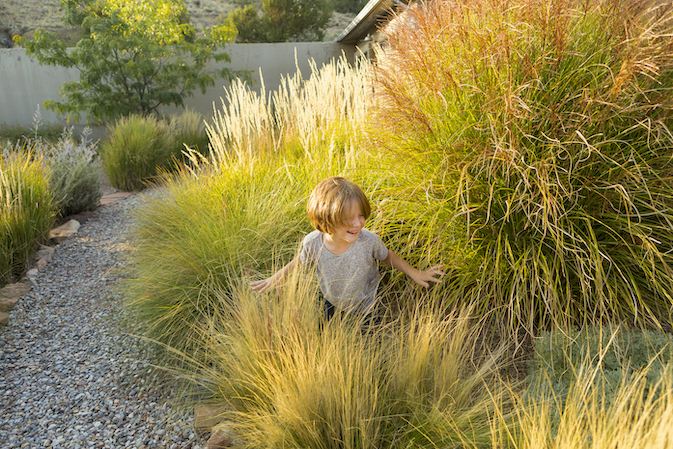
Regardless of whether you have a ride-on, electric, or self-propelling lawn mower, cutting the grass doesn’t come high on the list of enjoyable ‘to-do’s’ for most home owners. If that isn’t enough reason to quit your lawn in favour of less exhausting ground cover options, there’s also the question of sustainability and habitat enhancement. Cutting the lawn uses fuel, whether its petrol or electricity, which means a cost to both your pocket and the environment. Quitting a mono-species lawn in favour of more diverse plantings provides birds and insects (many of them native) with an environment offering nesting and feeding grounds. Which is why many Kiwis are turning to native grasses to fill the spaces where time- and energy-demanding lawns once dominated.
As well as benefiting the environment, native grasses also add texture and movement to the landscape, and because they are native, they’re built to thrive, with little coaxing, in our own backyard. For those who are keen on the idea, there are native grasses for all situations. In wet settings, pretty sedges such as Carexes ‘secta’ and ‘virgata’ offer interesting form and dark seed heads, respectively. Clumps of Juncus pallidus stand stately tall in tidy clumps, and silvered, salty-wind-tolerant Apodasmia similis (Oioi) offers upright groundcover in coastal situations.
Tussocks, glorious when whipped up by the wind, thrive in dry conditions, and there is such a range to choose from. Introduce colour with orange Carex testacea, reds via Chionochloa rubra, and blues and silver with Fetuca coxii, and Poa cita.
Planting aside, just where do we begin to make the transition from lawn to native grasses, especially where cost is an issue. Fortunately, it’s not always necessary to bring in the big guns to dig up and remove turf. A more simple solution, especially where troublesome invasive weeds such as kikuyu, couch, and convolvulus are not present, is to solarise lawns during the hottest months of the year. This involves laying black plastic over lawn and weighing it down firmly at the edges with bricks, stones, or wire pegs. As the sun does its work over a period of weeks (depending on how hot the days are), the grass will burn off. To further reduce the likelihood of lawn grass returning, once the black plastic has been removed, the area can be overlaid with thick wads of cardboard, and topped with a 10cm layer of bark mulch. Through these layers your chosen grasses can then be planted. Where invasive weeds are a problem, weed matting should be laid down before the cardboard and mulch is applied. Any invasives can then be touch sprayed (where it is safe to do so) as they make a reappearance.
Native grasses never look more impressive than when planted en mass in single species. But there are other ways to achieve a desirable effect: mixed borders of grasses provide a mix’n’match colour and texture every bit as interesting as a perennial border, especially as they flower and seed. Among these borders, consider adding plantings of grasses in raised terracotta pots, or incorporating a decorative bird bath. A compatibly coloured rose or two won’t go amiss among grasses, either, but look for colour-spot species that are happy to grow in your chosen environment. Dry grassland situations, for example, will be happy to support verbascum, Rose Campion, purple viper’s-bugloss, and soldier poppies. Wetter areas will host hosta, Solamon’s seal, and hydraenga.
Although native grasses are easy care once established, they will require regular watering in the early stages, especially over the first 2-3 dry summer seasons. But once they are away, they will lock in their own moisture through their dense self-mulching capabilities. Once your grass garden is established, you will never be able to look at a flat, green, monocultural, lawn the same way!