
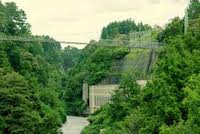
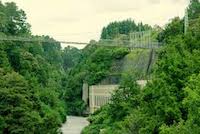
He’d once taken a tentative venture out on to the Arapuni swing bridge, and some people are a bit like that when it comes to heights, especially if it’s as high and wide open as that interesting old bridge. Now more than 80 years old, and almost 100 metres above the gushing green waters of the Waikato River, it’s a spectacular piece of construction to walk across.
Yet for those who can brave the almost inevitable feeling of vertigo from such an eyrie, it’s a great sight and one well worth the visit.
Originally built in 1925 as a footbridge for workers from the Arapuni village to cross to the Arapuni hydro dam construction site on the west side of the river, the bridge is now a well-preserved piece of the rich history of the Waikato. Fortunately, Mighty River Power, as guardians and custodians of that section of the river, have taken responsibility for the restoration and maintenance of the bridge, ensuring that it remains in good condition.
This requires regular work that costs the power company $10,000 a year, and some time ago the structure was given a major overhaul to keep it adequately safe for future generations to walk across if they dare.
The big refurbishment included the replacement of droppers (the perpendicular steel cables carrying the bridge platform) and the installation of new tread boards on the bridge footpath. As well, the main anchor points on both sides of the river, securing the massive 60mm-thick twisted steel cables that hold up the entire bridge, were also refurbished.
For those who’ve never stepped out on to a swing-bridge such as this, the Arapuni structure is certainly a breath-taking piece of work, the more so considering that it was built with what these days would be considered rather basic equipment.
It bursts out from the east (true right) bank of the Waikato River 97.5 metres above the water, straight off an almost sheer cliff face that plunges down with gut-wrenching steepness. The path to this eastern access is through a pleasant, neat little park area in the Arapuni village, leading down through a rough cutting on to the high edge of the bank. But you can’t see the river until a final right-angle left turn brings you abruptly on to the bridge which suddenly swoops away out in front.
It is 146 metres long, with a metre-wide board-walk covered with small-mesh wire netting to prevent slipping in the wet, and there’s a sign on the pathway down to it which warns that the bridge can take only 30 pedestrians at a time, that people should be a metre apart while on the bridge, and neither motorbikes nor horses are allowed on it either. There’s a 12-metre slope from east to west, and the cyclone wire sides mean there’s almost completely open viewing straight down on to the crowns of ponga and pines and other trees on the banks, even for little kids. Adults and taller youngsters can lean over the top rail and have an unobstructed view that plummets straight down under their feet. From further out on the bridge, one looks straight on to the green waters of the Waikato as they roil and churn out of the power house turbines and race over a small weir and on down the gorge.
The power house itself, square and squat and clinging to the sheer rock walls of the west bank of the gorge, looks every bit like it was constructed in the 1920s. It was, in fact, commissioned in 1929, the first of the Waikato River’s nine hydro dams, and its design is entirely functional – it’s there to do a job, and that’s what it’s been doing satisfactorily for the past 80 years.
During World War Two the blocky building was painted in camouflage colours and had trees and other plants all over it, in a totally inadequate attempt to hide it from any marauding enemy bomber planes that may have come hunting. In those days it was a major and vital source of electricity. These days it is an almost forgotten little place that just sits there quietly, still churning out power for the nation.
Inside, the power house is a warren of narrow passages, humming machinery and bare concrete, with dim light filtering in through windows misted with ancient grime. There is too a steep, narrow staircase of more than 350 stairs that burrows upwards in a manner that appears as a strange illusion to the eyes.
But from high above, standing in the middle of the swing bridge and looking upstream, there is the bushclad gorge down which the river originally ran. It is a 100-metre straight-sided rock channel not much over 30 metres wide at its narrowest point, and the water must have blasted through there in a spectacular raging torrent in its unfettered days.
The western quarter of the bridge has recently been enclosed with a heavy mesh roof to stop fools and idiots throwing empty bottles and other debris down on to the power station and workers’ cars below.
On that western side there is a narrow tarseal road, now open only to foot traffic. To the right it leads down to the power house, and also to a bridge across the river, 300 metres below the swing bridge.
Until recently this road was open to public motorists, but Mighty River Power has reluctantly closed it – the lonely little stretch had become a dumping ground for junk cars: 50 wrecks in one year were left there by gormless gits.
There’s also a large, sturdy steel tower on that true left bank side, which carries the main support steel ropes to their anchor points in a patch of native bush above the roadway. The tower bears an encrusted heavy cast-iron name plate which says, enigmatically: “David. Rowell & Co. Ltd. Engineers, Westminster”.
Uphill, there is a heavily-hewn rock wall where long-gone workmen hacked out the narrow roadway, and above it flaxes, native bush, pines and the relentless blackberry smother the ground. A little tunnel is also carved into the rock, a metre wide, stoop-head high, and perhaps 20 metres deep, though maybe it’s deeper for those who care to brave possible cave-weta territory. It appears glow-worms are dangling their beaded fishing lines at the back – but I didn’t have a torch to check closely.
Beyond it a cracked and battered old concrete staircase leads mysteriously up through the rock wall and disappears into the bush, but it’s wired off to prevent people like me nosing around where I shouldn’t be. Near the top of the road a towering plantation of Douglas fir leans out as though trying to see into the gorge.
And always, above the soughing of the wind through the firs, and the clicking and droning of ardent cicadas, there is the restless muttering of the river far below as it shoves and shoulders its way ever downstream.
The whole place has a quiet peacefulness about it, with a slightly sinister undercurrent of the powerful river only just managing to keep its strength in check.
It’s an interesting outing – and there’s a bunch of river trail walks in that area that I have yet to explore.
Kingsley Field is a columnist with the Waikato Times in Hamilton. His Outdoors columns appear fortnightly. He has recently published his second illustrated volume of the columns, and is now working on Volume III. He can be contacted at kingsley(at)accuwrite.co.nz